The Skill-Stacking Strategy: How to Build Competitive Advantage in 2026
Prism Skills Team
Learning Innovation
Being great at one thing used to be enough. Not anymore.
The new career math: One rare skill = valuable. Two complementary skills = very valuable. Three skills that rarely overlap = irreplaceable.
This is called skill-stacking, and it's how ordinary professionals become extraordinary assets.
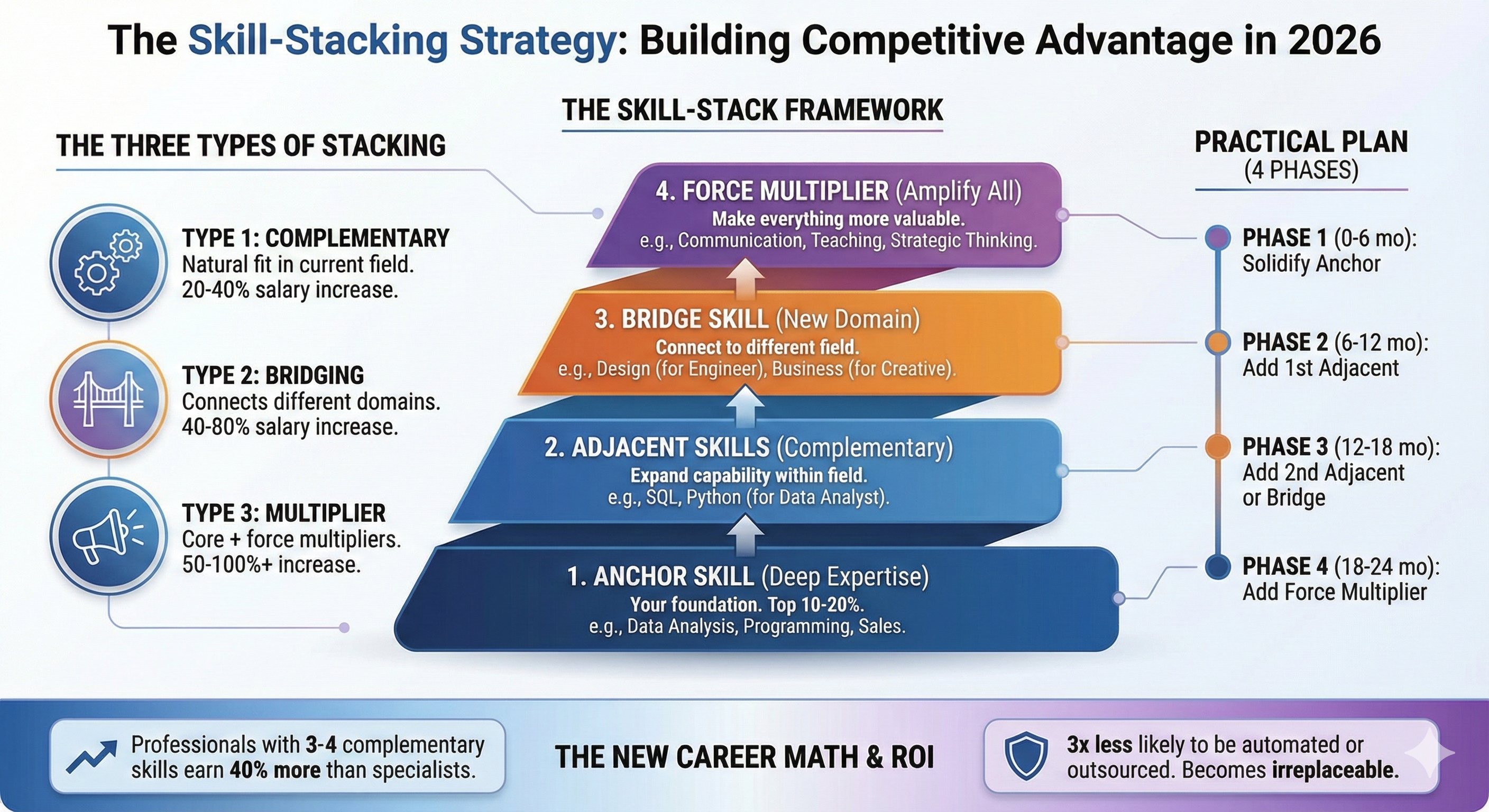
The data is clear: Professionals with 3-4 complementary skills earn 40% more than single-skill specialists and are 3x less likely to be automated or outsourced.
But here's the catch: most people stack skills randomly, hoping something valuable emerges. That's like building a house by randomly nailing boards together.
Strategic skill-stacking is different. It's deliberate, compounding, and creates career advantages that are almost impossible to replicate.
Here's how to do it.
Why Skill-Stacking Beats Specialization
The old model: Become the best at one thing. Go deep, not wide.
The problem: In 2026, being the best at one thing makes you:
- Easily replaceable (there's always someone cheaper or better)
- Vulnerable to automation (AI excels at narrow tasks)
- Limited in career paths (stuck in one track)
- Commoditized (your skill becomes a checkbox on job descriptions)
The new model: Stack 3-4 skills that create unique value when combined.
The T-Shaped Professional
You've probably heard of T-shaped skills:
- Vertical bar: Deep expertise in one area
- Horizontal bar: Broad competence across related areas
This is old advice. Everyone's trying to be T-shaped now. It's the new baseline.
The M-Shaped Professional (Skill-Stacker)
The real advantage comes from being M-shaped:
- Two deep verticals: Expertise in two different domains
- Connections between them: Ability to bridge and translate
Example M-shaped professional:
- Deep in: Data Science + Design Thinking
- Bridge: Uses data to inform user experience decisions
- Result: Rare combination that few possess
Why this matters: Companies don't just need data scientists. They need data scientists who can communicate with designers, understand user psychology, and influence product decisions.
That person is worth 2-3x a pure data scientist.
The Three Types of Skill-Stacking
Not all skill combinations are created equal. Here are the three strategic approaches:
Type 1: Complementary Stacking (Most Common)
What it is: Skills that naturally work together in your current field.
Examples:
- Marketing: Copywriting + Data Analytics + SEO
- Product Management: User Research + SQL + Roadmap Planning
- Finance: Financial Modeling + Python + Data Visualization
When to use: You're advancing within your current field and want to become more valuable in your domain.
Career impact: 20-40% salary increase, faster promotions, harder to replace
How long to build: 12-18 months for 3-skill stack
Type 2: Bridging Stacking (High Value)
What it is: Skills from different domains that create unique intersections.
Examples:
- Technical + Business: Software Engineering + Sales = Sales Engineer
- Creative + Analytical: Design + Data Science = Data Visualization Specialist
- Domain + Technical: Healthcare + AI = Healthcare AI Consultant
When to use: You want to carve out a unique niche or transition between fields.
Career impact: 40-80% salary increase, access to new markets, consulting opportunities
How long to build: 18-36 months for 2-3 skill bridge
Type 3: Multiplier Stacking (Highest Leverage)
What it is: Core skills + force multipliers that amplify everything else.
Force multipliers:
- Communication: Makes any technical skill 2x more valuable
- Teaching: Positions you as expert, opens leadership paths
- Systems thinking: Elevates you from doer to strategist
- Storytelling with data: Turns analysis into influence
Examples:
- Data Analyst + Public Speaking = Thought Leader
- Engineer + Writing = Technical Content Creator
- Designer + Business Strategy = Design Director
When to use: You're already competent in a core skill and want to accelerate advancement.
Career impact: 50-100%+ increase, leadership roles, industry recognition
How long to build: 6-12 months to add one multiplier to existing expertise
The Skill-Stacking Framework
Here's how to build your stack strategically:
Step 1: Identify Your Anchor Skill
Your anchor is your deepest expertise. The skill you're in the top 10-20% at.
Questions to identify your anchor:
- What do people come to you for help with?
- What skill could you teach a beginner?
- What do you do better than most people in your role?
- What skill appears on your resume with 3+ years experience?
Common anchors:
- Technical: Programming, data analysis, design, engineering
- Business: Sales, marketing, operations, finance
- Creative: Writing, video production, graphic design
- People: Management, recruiting, training, coaching
Write down your anchor: _______________________
If you don't have an anchor yet, build one first. Skill-stacking requires at least one strong foundation.
Step 2: Map Adjacent Skills (Complementary Stacking)
Adjacent skills are in your field but expand your capability.
For each anchor, identify 3-5 adjacent skills:
Anchor: Data Analysis
- Adjacent: SQL, Python, Tableau, Statistics, Business Intelligence
Anchor: Product Management
- Adjacent: User Research, A/B Testing, SQL, Roadmapping, Stakeholder Management
Anchor: Content Marketing
- Adjacent: SEO, Copywriting, Analytics, Social Media, Email Marketing
Choose 2-3 adjacent skills that:
- Fill gaps in your current capabilities
- Are frequently mentioned in job descriptions for your target role
- You'll actually use within 30 days
Your adjacent skills: _______________________, _______________________
Step 3: Identify Your Bridge Skill (Optional but Powerful)
A bridge skill connects you to a different domain, creating rare combinations.
Bridge skill examples:
If you're technical, bridge to:
- Business (understanding P&L, ROI, business models)
- Design (UX principles, user research, visual communication)
- Sales (customer psychology, negotiation, presentation)
If you're in business, bridge to:
- Technical (basic coding, data analysis, automation)
- Creative (design thinking, storytelling, content creation)
- Operations (process optimization, project management)
The test: Does this skill open doors to a different department, industry, or market?
Your bridge skill (if applicable): _______________________
Step 4: Add a Force Multiplier
Force multipliers make everything else more valuable.
Top 5 force multipliers for 2026:
- Data storytelling: Turn analysis into influence
- Public speaking/presentation: Amplify your ideas
- Writing: Scale your expertise, build reputation
- Teaching/coaching: Position as expert, build network
- Strategic thinking: Elevate from execution to strategy
Pick ONE that complements your stack and your personality.
Your force multiplier: _______________________
Step 5: Validate Your Stack
Before investing time, validate that your stack is actually valuable.
The validation checklist:
✅ Market demand: Are people hiring for this combination?
- Search job boards for your stack
- Are roles explicitly asking for these combinations?
- What do they pay?
✅ Rarity: Is this combination uncommon?
- Search LinkedIn for people with your exact stack
- If <1,000 results, it's rare enough
- If >10,000, it might be too common
✅ Synergy: Do these skills multiply each other's value?
- Can you do something with the combination that you can't do with skills individually?
- Do they solve a specific, valuable problem?
✅ Personal interest: Will you actually enjoy using this stack?
- Don't build a stack you'll hate using
- Motivation matters for 18+ month journeys
If your stack passes all four tests, proceed. If not, adjust.
Real Skill-Stack Examples (And Their ROI)
Example 1: The Data Storyteller
Anchor: Data Analysis (4 years experience)
Adjacent: SQL, Python, Statistical Analysis
Bridge: None
Multiplier: Data Visualization + Storytelling
Before stack:
- Role: Data Analyst
- Salary: $75K
- Impact: Produces reports that sit unread
After stack (18 months):
- Role: Analytics Lead
- Salary: $105K (+40%)
- Impact: Influences executive decisions through compelling data narratives
The difference: Adding storytelling + visualization transformed technical output into strategic influence.
Example 2: The Technical Product Manager
Anchor: Software Engineering (5 years)
Adjacent: None
Bridge: Product Management (user research, roadmapping)
Multiplier: Stakeholder Communication
Before stack:
- Role: Senior Software Engineer
- Salary: $120K
- Impact: Builds what's assigned
After stack (24 months):
- Role: Technical Product Manager
- Salary: $160K (+33%)
- Impact: Defines what to build AND builds it
The difference: Bridging to product management created a rare "unicorn PM" who can code.
Example 3: The AI-Powered Marketer
Anchor: Content Marketing (3 years)
Adjacent: SEO, Copywriting
Bridge: AI Tools (prompt engineering, automation)
Multiplier: Analytics
Before stack:
- Role: Content Marketer
- Salary: $60K
- Output: 4 blog posts/month manually
After stack (12 months):
- Role: AI-Enhanced Content Lead
- Salary: $85K (+42%)
- Output: 20 pieces/month (AI-assisted), data-driven strategy
The difference: Being early to AI tools created massive productivity advantage.
Example 4: The Design-Minded Developer
Anchor: Front-end Development (4 years)
Adjacent: React, JavaScript, CSS
Bridge: UX Design (user research, prototyping, design systems)
Multiplier: None
Before stack:
- Role: Front-end Developer
- Salary: $90K
- Impact: Implements designs
After stack (18 months):
- Role: Design Engineer
- Salary: $130K (+44%)
- Impact: Designs AND implements
The difference: Bridging to design eliminated handoff friction, increased autonomy.
How to Build Your Stack (The Practical Plan)
Don't try to build your entire stack at once. Use this sequence:
Phase 1: Solidify Your Anchor (0-6 months)
If your anchor isn't strong yet, get it to top 20% first.
Daily actions:
- 30 min deliberate practice
- Real-world application
- Feedback and iteration
Goal: People recognize you as competent in this area.
Phase 2: Add First Adjacent Skill (6-12 months)
Pick the adjacent skill with highest immediate ROI.
Daily actions:
- 20 min learning new skill
- Apply in current work
- Build portfolio examples
Goal: Functional proficiency (can do it independently).
Phase 3: Add Second Adjacent or Bridge (12-18 months)
Decision point: Go deeper in your domain (adjacent) or bridge to new domain?
Choose adjacent if:
- You love your current field
- Clear promotion path in domain
- Want to be irreplaceable specialist
Choose bridge if:
- Want career optionality
- See opportunity in adjacent markets
- Feel limited by current domain
Daily actions:
- 20 min on new skill
- Find cross-application opportunities
- Network in new domain (if bridging)
Goal: Working competence + portfolio proof.
Phase 4: Add Force Multiplier (18-24 months)
Now add the skill that amplifies everything.
Daily actions:
- Practice your multiplier (speaking, writing, teaching)
- Combine with existing stack
- Build public visibility
Goal: Known for your unique combination.
Common Skill-Stacking Mistakes
Mistake 1: Random Stacking
The trap: "I'll learn whatever sounds interesting"
Why it fails: Skills don't compound, you end up with scattered abilities
Fix: Choose skills strategically based on market demand and synergy
Mistake 2: All Breadth, No Depth
The trap: "I'll be good at everything"
Why it fails: Jack of all trades, master of none = not valuable
Fix: Anchor first, then expand
Mistake 3: Ignoring Market Demand
The trap: "This combination is unique, so it must be valuable"
Why it fails: Unique ≠ valuable. Unicorn + basketball = useless
Fix: Validate that someone will pay for your combination
Mistake 4: Building in Isolation
The trap: Learning without applying
Why it fails: Can't prove competence, skills don't integrate
Fix: Apply immediately in current role, build public portfolio
Mistake 5: Impatience
The trap: Expecting results in 3 months
Why it fails: Skill-stacking takes 18-36 months to pay off
Fix: Trust the process, measure progress quarterly
The 2026 Skill-Stacking Meta
What's working in 2026:
Hot Stacks (High Demand):
Technical + AI:
- Any core skill + AI tool proficiency
- Example: Marketing + AI Content Tools
- Why: Early movers capturing massive productivity gains
Data + Domain:
- Data analysis + industry expertise
- Example: Healthcare + Data Science
- Why: Domain knowledge makes data actionable
Creative + Analytics:
- Design/content + data-driven decision making
- Example: UX Design + A/B Testing
- Why: Rare combination, high impact
Technical + Communication:
- Engineering + writing/speaking
- Example: Developer + Technical Writing
- Why: Explaining complexity is valuable
Cooling Stacks (Declining Value):
- Pure coding without business context
- Marketing without analytics
- Design without user research
- Any stack without an AI angle
Emerging Stacks (Get in Early):
- Sustainability + Business Strategy
- AI Ethics + Product Management
- Web3/Blockchain + Legal/Compliance
- Climate Tech + Any Domain
Your 90-Day Skill-Stacking Sprint
Start building your stack today:
Weeks 1-4: Stack Design
- Identify your anchor skill
- Map 5 adjacent skills
- Choose your bridge or multiplier
- Validate market demand
- Create learning plan
Weeks 5-8: Foundation Building
- Daily practice on first new skill (20 min)
- Apply in current work
- Document examples
- Join community in new area
Weeks 9-12: Integration
- Combine new skill with anchor
- Create portfolio piece
- Share publicly (LinkedIn, blog)
- Get feedback, iterate
After 90 days: Assess progress, decide on next skill to add.
The Compounding Effect
Here's what happens over 3 years of strategic skill-stacking:
Year 1:
- Build anchor + 1 adjacent skill
- 20% more valuable
- Modest salary bump
Year 2:
- Add bridge or second adjacent
- 40% more valuable
- Significant promotion or job change
Year 3:
- Add multiplier
- 60-80% more valuable
- Rare combination, premium positioning
- Multiple career paths available
Year 5:
- Recognized expert in unique intersection
- Consulting opportunities
- Leadership roles
- Career optionality
The kicker: Your stack becomes harder to replicate over time. Early movers win.
The Bottom Line
Specialization made you good at your job.
Skill-stacking makes you irreplaceable.
The professionals who thrive in 2026 aren't the ones who go deepest in one narrow area. They're the ones who strategically combine 3-4 skills into unique, high-value combinations.
Start stacking today:
- Identify your anchor
- Choose your first adjacent/bridge skill
- Invest 20 minutes daily
- Apply immediately
- Build in public
In 18-24 months, you'll have a combination that few others possess.
And in a world of AI, automation, and global competition, rare and valuable is the only sustainable advantage.
What will your stack be?