Learning Velocity: How Fast-Growing Professionals Accelerate Skill Development
Prism Skills Team
Learning Innovation
Two professionals start learning Python on the same day. Same course. Same starting point.
Six months later:
- Person A can write basic scripts, still Googling syntax
- Person B has automated their job, built three portfolio projects, and just got promoted
Same time invested. Wildly different results.
The difference isn't intelligence, talent, or time available. It's learning velocity—how much capability you gain per hour of learning.
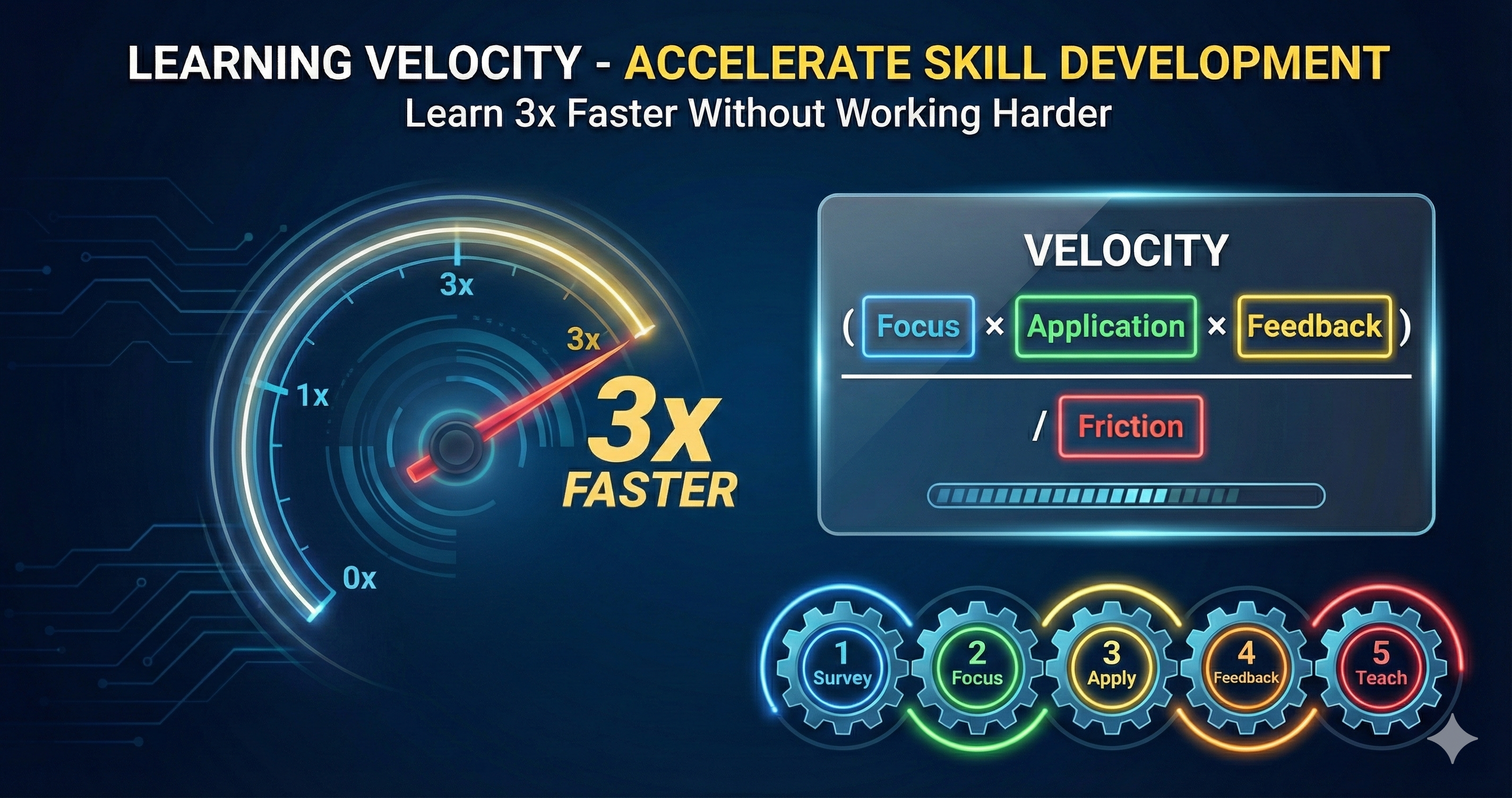
Research shows: High-velocity learners develop proficiency 3x faster than average learners. They're not working harder. They're working smarter.
Here's how they do it.
What Is Learning Velocity?
Traditional view of learning: Time × Effort = Results
Reality: (Time × Effort) × Velocity = Results
Learning velocity is your rate of skill acquisition per unit of time.
The Velocity Formula
Learning Velocity = (Focus × Application × Feedback) / Friction
Let's break that down:
Numerator (what accelerates learning):
- Focus: Concentrated attention on high-value concepts
- Application: Immediate use of new knowledge
- Feedback: Rapid correction of errors
Denominator (what slows learning):
- Friction: Obstacles, distractions, inefficiencies
The math: Increase the top, decrease the bottom, velocity goes up exponentially.
Why Velocity Matters More Than Volume
Low velocity learner:
- 100 hours of learning
- Low focus (multitasking, distractions)
- No application (just consuming)
- No feedback (no one checking work)
- High friction (switching platforms, finding materials)
- Result: Minimal capability gain
High velocity learner:
- 30 hours of learning
- Maximum focus (deep work blocks)
- Immediate application (building real projects)
- Rapid feedback (iterating quickly)
- Minimal friction (streamlined system)
- Result: Significant capability gain
Same content, 70% less time, better outcome.
That's velocity.
The Five Gears of Learning Velocity
Think of learning velocity like a car transmission. You need different gears for different situations.
Gear 1: Survey Mode (Overview Phase)
When to use: Beginning a new skill or domain
Velocity strategy: Breadth before depth
What it looks like:
- Skim 5-10 resources quickly
- Watch overview videos at 2x speed
- Read table of contents, not full chapters
- Identify key concepts, not mastery
Time investment: 2-4 hours total
Goal: Mental map of the domain, not expertise
Velocity boost: Prevents going deep in wrong areas
Example: Learning data science? Survey statistics, Python, SQL, visualization in 4 hours before choosing which to learn first.
Gear 2: Focused Learning (Skill Acquisition)
When to use: Building a specific skill
Velocity strategy: Deliberate practice on fundamentals
What it looks like:
- 20-30 minute focused sessions
- Single topic per session
- Active recall (test yourself constantly)
- Spaced repetition (review on schedule)
Time investment: 30 min/day × 30 days = 15 hours
Goal: Functional proficiency in core concepts
Velocity boost: Prevents wasted time on edge cases before mastering basics
Example: Learn SQL fundamentals (SELECT, WHERE, JOIN) in 30 days before advanced optimization.
Gear 3: Application Mode (Making It Real)
When to use: You understand basics, need to internalize
Velocity strategy: Build, don't just learn
What it looks like:
- Use new skill to solve real problems
- Start simple projects immediately
- Fail fast, iterate
- Document what you build
Time investment: 2-4 hours/week on projects
Goal: Turn knowledge into capability
Velocity boost: Application is 10x more effective than passive learning
Example: Don't just learn Excel formulas—automate your actual work spreadsheet.
Gear 4: Feedback Integration (Rapid Correction)
When to use: Throughout all phases
Velocity strategy: Get corrected before bad habits form
What it looks like:
- Code reviews from senior developers
- Design critiques from experienced designers
- Show your work to experts early
- Use AI tools for instant feedback
Time investment: 30 min/week seeking feedback
Goal: Course-correct before going too far wrong
Velocity boost: Prevents practicing errors for months
Example: Ship ugly MVP, get feedback, iterate. Don't perfect in isolation.
Gear 5: Teaching Mode (Mastery Acceleration)
When to use: You're 60-70% proficient
Velocity strategy: Teach to solidify understanding
What it looks like:
- Write blog posts explaining concepts
- Help beginners in communities
- Create tutorials or documentation
- Mentor someone junior
Time investment: 1-2 hours/week teaching
Goal: Identify gaps in your understanding
Velocity boost: Teaching reveals what you don't actually understand
Example: Write a "What I learned building my first API" post after your first project.
The Velocity Killers (And How to Eliminate Them)
Most people think they're learning slowly because they're not smart enough. Wrong. They're learning slowly because of friction.
Friction 1: Tutorial Hell
What it is: Endlessly consuming courses without building
Why it kills velocity: No application = no retention
The trap: "I'll just finish one more course before I start building"
How to eliminate it:
- 30/70 rule: 30% learning, 70% building
- Stop a tutorial halfway through and build something
- Ban yourself from new courses until you've built with the last one
Velocity gain: 3-5x faster capability development
Friction 2: Context Switching
What it is: Jumping between topics, platforms, methods
Why it kills velocity: Each switch costs 15-30 minutes of mental reload time
The trap: "I'll learn Python AND JavaScript AND SQL simultaneously"
How to eliminate it:
- One skill at a time for 30-90 days minimum
- Batch all learning sessions for that skill
- Use one primary resource, not ten
- Same time, same place daily
Velocity gain: 2x faster by eliminating switching costs
Friction 3: Perfectionism
What it is: Polishing everything before moving forward
Why it kills velocity: Wastes time on diminishing returns
The trap: "My code isn't clean enough to show anyone yet"
How to eliminate it:
- Ship ugly: Get feedback on messy v1, not perfect v5
- 80/20 rule: Stop at "good enough," move to next concept
- Timeboxing: Give yourself 2 hours, ship whatever you have
Velocity gain: 2-3x faster iteration cycles
Friction 4: Passive Learning
What it is: Watching, reading, highlighting without doing
Why it kills velocity: Illusion of learning, no actual capability
The trap: "I watched 20 hours of videos, why can't I do this?"
How to eliminate it:
- No consumption without production
- Watch tutorial → Immediately replicate
- Read chapter → Immediately apply
- Learn concept → Immediately test yourself
Velocity gain: 5-10x better retention and capability
Friction 5: No Forcing Function
What it is: Learning without deadlines or stakes
Why it kills velocity: No urgency, infinite procrastination
The trap: "I'll learn when I have time" (never happens)
How to eliminate it:
- Public commitment: "I'll ship X by date Y"
- Paid course: Sunk cost creates urgency
- Project with deadline: Real deliverable forces completion
- Accountability partner: Weekly check-ins
Velocity gain: 2-3x faster completion rates
The High-Velocity Learning System
Here's the complete system high-performers use:
Phase 1: Strategic Selection (1-2 hours)
Don't learn randomly. Choose strategically.
Steps:
- What's your goal? (Be specific)
- What skill directly unlocks that goal?
- What's the minimum viable proficiency?
- What's your timeline?
Output: One clear skill target with deadline
Example: "Learn SQL to query customer data for my Q2 presentation (8 weeks)"
Phase 2: Resource Curation (30 min)
Don't browse. Decide once, commit fully.
Steps:
- Find ONE primary resource (course, book, tutorial)
- Find ONE supplementary resource (community, mentor, AI tool)
- Ignore everything else
Output: Your complete learning stack
Example: Primary = DataCamp SQL course. Supplementary = SQL chatbot for questions.
Phase 3: Deliberate Practice (30 min/day × 30-90 days)
Don't casually study. Practice deliberately.
Daily routine:
- 10 min: Review previous day's concepts (active recall)
- 15 min: Learn one new concept (focused study)
- 5 min: Apply immediately (micro-project or exercise)
Weekly:
- 2 hours: Build something real with the week's learning
- 30 min: Get feedback on what you built
Output: Functional proficiency
Phase 4: Forced Application (Ongoing)
Don't wait to be "ready." Use it now.
How:
- Week 2: Use new skill on toy problem
- Week 4: Use new skill on work-related task
- Week 6: Ship small project publicly
- Week 8: Teach someone what you learned
Output: Proven capability, not just knowledge
Phase 5: Velocity Audit (Monthly)
Don't assume you're improving. Measure.
Questions:
- Can I do things today I couldn't do 30 days ago? (List them)
- Am I learning faster or slower than last month?
- What friction am I experiencing?
- What would 2x my velocity?
Output: Adjustments to system
Real Learning Velocity Examples
Example 1: The 90-Day Data Analyst
Person: Marketing coordinator, no technical background
Goal: Get promoted to Marketing Analyst
Velocity approach:
- Gear 1: Surveyed Excel, SQL, Tableau (4 hours)
- Gear 2: Focused on SQL fundamentals (30 min/day × 30 days)
- Gear 3: Automated her weekly reporting (applied immediately)
- Gear 4: Posted messy queries in Slack, got feedback
- Gear 5: Wrote internal "SQL for Marketers" guide
Friction eliminated:
- One resource only (SQLZoo)
- Daily learning at 8 AM (no context switching)
- Shipped ugly queries (no perfectionism)
- Real work projects (no tutorial hell)
Result: Promoted in 90 days, now running team analytics
Velocity: ~3x faster than typical "learn SQL" journey
Example 2: The Rapid Product Manager
Person: Software engineer wanting to transition to PM
Goal: Land PM role within 6 months
Velocity approach:
- Gear 1: Read 3 PM books at 2x speed, took notes (6 hours)
- Gear 2: Focused on user research methods (2 weeks intensive)
- Gear 3: Volunteered to lead product feature at current job
- Gear 4: Got weekly feedback from PM mentor
- Gear 5: Blogged about engineering→PM transition
Friction eliminated:
- Stopped coding bootcamps, focused only on PM skills
- Used actual work as practice ground (forced application)
- Public blog created accountability
- Mentor provided rapid course correction
Result: Landed PM role at startup in 5 months
Velocity: Compressed typical 2-year transition into 5 months
Example 3: The AI-Accelerated Marketer
Person: Content marketer, worried about AI replacing job
Goal: Become AI-enhanced marketer (irreplaceable)
Velocity approach:
- Gear 1: Tested 10 AI tools in one weekend
- Gear 2: Deep-dived ChatGPT + Midjourney (1 month)
- Gear 3: Used AI for all content production immediately
- Gear 4: A/B tested AI vs manual, optimized prompts
- Gear 5: Trained team on AI workflow
Friction eliminated:
- No courses, just hands-on experimentation (avoid tutorial hell)
- Used real work, not side projects (forced application)
- Measured output: went from 4 posts/month → 20 posts/month
- Became known internally as "AI expert"
Result: Promoted to AI Strategy Lead, 40% raise
Velocity: 6 months from beginner to thought leader
Velocity Hacks for Specific Learning Styles
For Visual Learners
Velocity boosters:
- Draw diagrams while learning
- Use visualization tools (mind maps, flowcharts)
- Watch video at 1.5-2x speed with subtitles
- Create visual portfolio of work
Example: Learning APIs? Draw the request/response flow while building
For Kinesthetic Learners
Velocity boosters:
- Type along with tutorials (don't just watch)
- Build physical prototypes if possible
- Stand/walk while listening to concepts
- Use simulation environments
Example: Learning cloud computing? Build actual infrastructure, don't just read docs
For Verbal Learners
Velocity boosters:
- Teach concepts out loud to rubber duck
- Join study groups, explain to others
- Record yourself explaining concepts
- Write blog posts or documentation
Example: Learning statistics? Explain each concept to voice recorder
For Reading/Writing Learners
Velocity boosters:
- Take detailed notes in your own words
- Write summaries after each session
- Create cheat sheets and reference guides
- Maintain learning journal
Example: Learning frameworks? Create your own reference documentation
The Velocity Multipliers
These accelerate any learning approach:
Multiplier 1: Micro-Deadlines
Instead of: "I'll learn Python this year"
Do this: "I'll build a working calculator by Friday"
Velocity boost: 3-5x faster completion
Multiplier 2: Public Commitment
Instead of: Learning privately
Do this: Tweet "Building a weather app this week, shipping Friday"
Velocity boost: 2-3x higher follow-through
Multiplier 3: AI Tutoring
Instead of: Googling errors for hours
Do this: Paste error into ChatGPT, get instant explanation
Velocity boost: 5-10x faster debugging
Multiplier 4: Community Immersion
Instead of: Learning alone
Do this: Join Discord/Slack, ask questions, help others
Velocity boost: 2x via network effects
Multiplier 5: Cross-Application
Instead of: Learning skill in isolation
Do this: Use in multiple contexts immediately
Velocity boost: 3-4x retention
Example: Learn SQL → Use for work analytics, personal finance tracking, AND side project
Your 30-Day Velocity Experiment
Test your learning velocity with this structured experiment:
Week 1: Baseline Measurement
Pick a skill you want to learn (be specific)
Measure current state:
- What can you do today? (List capabilities)
- How fast are you progressing? (Estimate)
- What's slowing you down? (Identify friction)
Choose your gear: Survey? Focused learning? Application?
Week 2: Eliminate Top Friction
Identify your #1 friction from the velocity killers:
- Tutorial hell?
- Context switching?
- Perfectionism?
- Passive learning?
- No forcing function?
Eliminate it completely for one week
Example: If tutorial hell → Stop all courses, only build
Week 3: Add One Velocity Multiplier
Choose one:
- Micro-deadlines
- Public commitment
- AI tutoring
- Community
- Cross-application
Implement fully for one week
Example: Tweet daily progress, ship something public Friday
Week 4: Measure Velocity Gain
Compare to Week 1:
- What can you do now that you couldn't before?
- How much faster are you learning?
- What changed?
Calculate your velocity gain: "I'm learning X% faster"
Decide: Keep this system or iterate further?
The Bottom Line
Time spent learning ≠ Capability gained
The professionals winning in 2026 aren't spending more time learning. They're learning at higher velocity.
The velocity formula:
(Focus × Application × Feedback) / Friction
Increase the top:
- ✅ Focus: Single skill, deep work blocks
- ✅ Application: Build immediately, don't just consume
- ✅ Feedback: Ship early, iterate based on corrections
Decrease the bottom:
- ✅ Eliminate tutorial hell
- ✅ Stop context switching
- ✅ Ship ugly, iterate in public
- ✅ Use forcing functions
Result: 3x faster skill development in same time
Your move: Pick one skill. Apply the velocity framework. Measure results in 30 days.
The gap between where you are and where you want to be isn't about time.
It's about velocity.
Accelerate.