From Knowledge to Application: Closing the Practice Gap
Prism Skills Team
Learning Innovation
Sarah just finished a highly-rated SQL course. Spent 40 hours. Got a certificate. Felt accomplished.
Monday morning, her manager asks her to pull customer segmentation data for a campaign. She opens the database... and freezes. The course taught her SELECT statements, JOINs, and WHERE clauses. But she has no idea how to translate her manager's business question into working SQL.
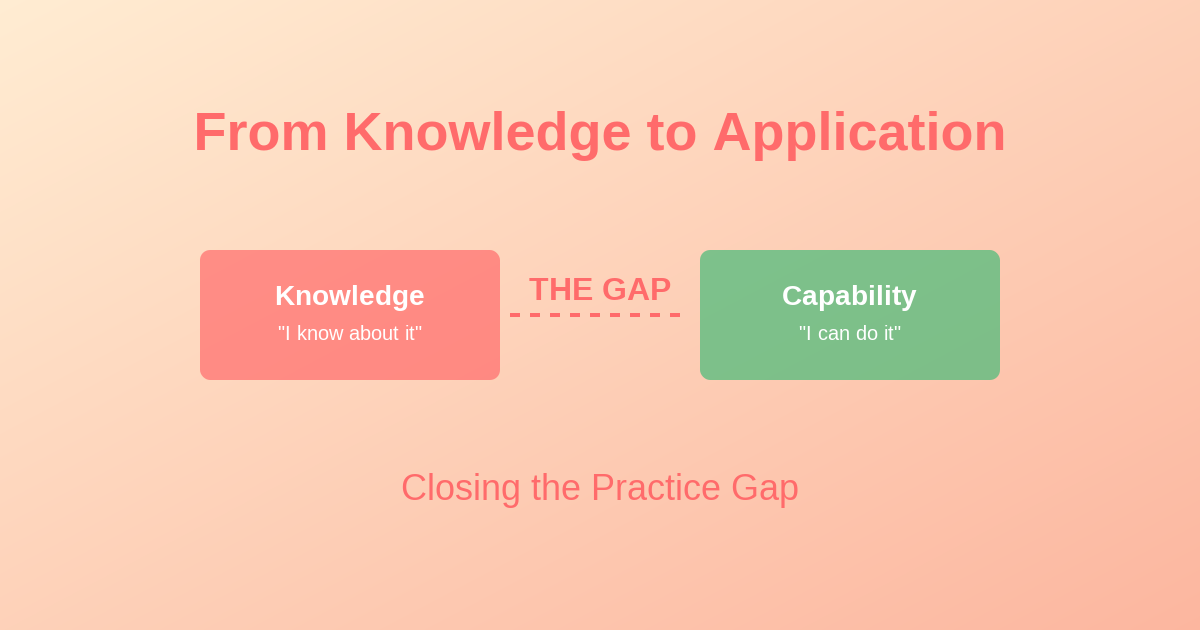
Welcome to the practice gap—the chasm between knowing about something and being able to do it.
85% of professional training fails right here. Not because people don't learn. But because learning isn't the same as capability.
The Illusion of Knowledge
Let's run an experiment. After reading each statement, rate your confidence from 1-10:
Statement 1: "I understand how A/B testing works."
Statement 2: "I can design and run an A/B test for our next product feature."
Most people rate themselves 7-8 on statement 1 and 3-5 on statement 2.
That gap? That's the practice gap.
Understanding = You can explain the concept, pass a quiz, discuss it intelligently
Capability = You can execute the skill effectively in real-world situations
Traditional training optimizes for understanding. The job market cares about capability.
The 70-20-10 Model (And Why We Ignore It)
In the 1980s, researchers at the Center for Creative Leadership studied how executives developed their skills. The findings became known as the 70-20-10 model:
- 70% of development comes from on-the-job experiences
- 20% from coaching and learning from others
- 10% from formal training
Yet look at how most corporate learning budgets are allocated:
- 70% to formal training (courses, workshops, conferences)
- 20% to content libraries and tools
- 10% to experiential learning and coaching
We've inverted the model. We're spending the most money on the least effective method.
Why? Because formal training is easy to buy, track, and check a box. Real practice is messy, hard to standardize, and difficult to measure.
But you can't scale incompetence just because it's easy to measure.
The Three Types of Knowledge (And Which One Matters)
Declarative knowledge: Facts and concepts
Example: "An API is an application programming interface that allows two systems to communicate."
Procedural knowledge: How to execute steps
Example: "To call an API, you send an HTTP request with specific headers and parameters."
Transfer knowledge: Ability to apply in new contexts
Example: "When our payment system went down, I diagnosed it as an API authentication failure, tested the connection, and fixed it by regenerating expired credentials."
Traditional training delivers: Declarative knowledge, maybe procedural
The job requires: Transfer knowledge
This is why you can ace a course on Python but struggle to build a data pipeline for your actual business problem. You learned the syntax (procedural) but not how to think in Python (transfer).
Why Practice-Based Learning Is Different
Real capability requires something training alone can't provide: deliberate practice in realistic contexts.
Deliberate practice (a term coined by psychologist Anders Ericsson) has four elements:
-
Specific goals: Not "get better at SQL," but "write a query that segments customers by purchase frequency and recency"
-
Immediate feedback: You run the query, see if it works, understand why it failed, adjust, try again
-
Repeated attempts: You don't write one query and move on—you write 20 variations until pattern recognition develops
-
Just beyond current ability: Each task is slightly harder than the last, keeping you in the growth zone
Traditional courses offer: General goals, delayed feedback (wait for quiz results), one attempt per concept, uniform difficulty
Practice-based learning offers: Specific scenarios, instant feedback, multiple iterations, adaptive challenge
The difference is night and day.
The Transfer Failure Problem
Here's a dirty secret about traditional training: most learners can't transfer what they learned to new situations.
Classic study (Gick & Holyoak, 1980):
- Students learned a problem-solving strategy through an example
- When presented with a different problem requiring the same strategy, only 20% applied it
- Even when told the problems were related, only 60% made the connection
Why transfer fails:
1. Decontextualized learning: You learned SQL with a generic e-commerce database. Your job involves healthcare data with different schemas, compliance requirements, and business logic.
2. Surface-level processing: You memorized syntax without understanding when to use each approach or how to troubleshoot when things break.
3. No decision-making practice: The course told you what to do next. Your job requires you to figure out what to do next.
4. Single-context exposure: You saw one example of each concept. Real mastery requires seeing the same principle applied across multiple contexts.
The fix: Learn using scenarios that mirror your actual work, with variation in context but consistency in underlying principles.
The Knowing-Doing Gap in Action
Let's examine three common scenarios where the practice gap shows up:
Scenario 1: The Low-Code Builder
Jamie works in operations at a mid-sized healthcare company. She completed an online course on Retool (a low-code platform). The course was excellent—9/10 rating, covered all the features, clear examples.
The test: Her manager asks her to build an internal tool for nurses to log patient incidents.
What happens:
- She knows Retool has drag-and-drop components ✓
- She understands how to connect to a database ✓
- She can't figure out the data model for complex workflows ✗
- She doesn't know how to handle HIPAA compliance ✗
- She gets stuck on permission logic for different user roles ✗
- She has no idea how to make it intuitive for non-tech users ✗
The gap: The course taught her Retool features. Her job requires product thinking, data modeling, compliance awareness, and UX design—none of which the course covered.
Scenario 2: The Product Manager
Marcus is a finance analyst transitioning to product management. He took three courses: Product Strategy, User Research, and Agile Methodologies. He can define OKRs, explain the double-diamond process, and describe sprint ceremonies.
The test: He's assigned his first feature—improving the mobile app's account opening flow.
What happens:
- He knows he should talk to users ✓
- He doesn't know which users to talk to or what to ask them ✗
- He knows he should prioritize features ✓
- He doesn't know how to balance engineering constraints, business goals, and user needs when they conflict ✗
- He knows he should work with designers and engineers ✓
- He doesn't know how to communicate his vision when he's not fully sure of it himself ✗
The gap: The courses taught frameworks. His job requires judgment developed through repeated decision-making under uncertainty.
Scenario 3: The Data Analyst
Priya completed an intensive data visualization course. She learned Tableau inside and out, understands chart types, knows design principles.
The test: The executive team asks for a dashboard showing product performance.
What happens:
- She knows how to create beautiful charts ✓
- She doesn't know which metrics actually matter to executives ✗
- She can make technically correct visualizations ✓
- She doesn't know how to tell a story that drives decisions ✗
- She understands the data ✓
- She doesn't know what insights to highlight or when to raise red flags ✗
The gap: The course taught technical skills. Her job requires business acumen and strategic thinking.
The Practice-First Alternative
What if we flipped the model? Instead of: Learn → Practice → Apply
Try: Apply → Learn (what you need) → Apply better
Here's how it works:
Step 1: Present a Realistic Scenario
Not "Write a SQL query to find customers in California."
But: "Our marketing team is launching a campaign targeting high-value lapsed customers in specific regions. They need a list of customers who haven't purchased in 90-180 days, spent over $500 lifetime, and live in CA, NY, or TX. Pull this data and explain your methodology."
Same skill (SQL), but now you're making decisions about:
- Data quality (what if purchase dates are missing?)
- Business definitions (what counts as a "purchase"?)
- Stakeholder communication (how do you explain technical choices to marketers?)
Step 2: Struggle and Attempt
Before any explanation, you try. You make mistakes. You google things. You realize you don't know how to handle null values. You write a query that's technically correct but takes 5 minutes to run.
This struggle is the learning. Your brain is actively problem-solving, not passively consuming.
Step 3: Just-in-Time Instruction
Now—and only now—you get targeted help:
- "Your query is slow because you're not using indexed fields. Here's how indexing works..."
- "You're getting duplicate rows because of the join logic. Here's the difference between INNER JOIN and LEFT JOIN..."
Why this works: You have context. You know why you need this information. You're ready to receive it because you just experienced the problem it solves.
Step 4: Iterate and Refine
You fix your query. You run it again. You optimize it. You add error handling. You document your assumptions.
You're not just learning SQL—you're learning how to think like someone who solves data problems.
Step 5: Transfer to New Context
Next scenario: "Now pull similar data for our B2B customers instead of B2C. The data model is different, and you need to account for account hierarchies..."
Same principle (customer segmentation), different context. This is where transfer happens—you learn to apply the underlying skill pattern, not just repeat memorized steps.
The Simulation Advantage
The best practice environments don't use toy data or made-up scenarios. They simulate real work.
What makes a good simulation:
1. Authentic context: Healthcare simulations use actual (anonymized) patient data structures, compliance constraints, and workflow patterns.
2. Realistic constraints: You don't get infinite time or perfect information. You work with incomplete data, conflicting requirements, and ambiguous instructions—just like real work.
3. Consequential decisions: Your choices matter. If you design a poor data model, it comes back to bite you in later scenarios when you need to add features.
4. Multiple solution paths: There's no single "right answer." You can solve the problem multiple ways, each with trade-offs.
5. Expert coaching: When you get stuck, you get guidance—not the answer, but hints that help you think through the problem.
Example from low-code development:
Scenario: Build an expense approval workflow for a distributed team.
Realistic constraints:
- Some managers are in different time zones (async approval needed)
- Approval limits vary by region and department
- Finance needs audit trail for compliance
- Mobile access required for field staff
- Integration with existing accounting system
You're not just dragging components around in Retool. You're making architectural decisions about data modeling, state management, user permissions, notification logic, and error handling.
When you're done, you've built something that could (with some polish) actually be deployed. That's the difference between practicing and playing.
Designing Your Own Practice
You don't need a fancy simulation platform to close the practice gap. You can create practice opportunities in your current job.
Framework: The 3P Method
1. Prototype: Pick a small, low-stakes project at work. Build a rough version.
2. Present: Show it to colleagues/manager. Get feedback.
3. Polish: Incorporate feedback, improve it, document your learning.
Examples:
For SQL learners: "I'm going to create a weekly sales dashboard for our team. It won't be perfect, but I'll learn by doing."
For product managers: "I'm going to write a 1-page product brief for that feature idea we discussed, just to practice the thinking process."
For low-code builders: "I'm going to build a simple tool to track our team's sprint tasks. It'll help us, and I'll learn the platform."
The key: Don't wait for permission to practice. Find real problems to solve, even small ones.
When to Use Each Approach
Use traditional courses when:
- You're exploring a completely new field
- You need theoretical foundation before practice
- You want to understand the "why" behind concepts
Use practice-based learning when:
- You need to actually do the skill, not just understand it
- You're preparing for a specific role or project
- You've got basic knowledge and need to build capability
- You're tight on time and need results fast
Use a hybrid approach when:
- The skill requires both conceptual understanding and execution
- You're making a major career transition
- You want both breadth (theory) and depth (capability)
The Transfer Test
How do you know if you've actually closed the practice gap? Apply the transfer test:
Can you:
- Execute the skill in a context you've never seen before?
- Explain when to use this skill vs. alternative approaches?
- Troubleshoot when things go wrong?
- Teach the skill to someone else?
- Adapt the skill when requirements change mid-task?
If you can do all five, you've moved from knowledge to capability.
If you struggle with any, you still have a practice gap to close.
The Bottom Line
Completing a course is an accomplishment. But it's the beginning, not the end.
Knowledge is what you gain from courses.
Capability is what you gain from practice.
Value is what you create through applied capability.
The job market doesn't care about your certificate collection. It cares whether you can solve real problems under real constraints.
The fastest way to build capability isn't more courses—it's deliberate practice in realistic scenarios with immediate feedback and multiple iterations.
Stop collecting knowledge. Start building capability.
Then watch your career options expand.