Calculate Your Skills Investment ROI: Is Your Learning Worth It?
Prism Skills Team
Learning Innovation
New year, same question: "Should I invest in learning new skills, or is it a waste of time?"
Here's what most people do: Sign up for courses in January, feel productive for two weeks, abandon everything by February, repeat next year.
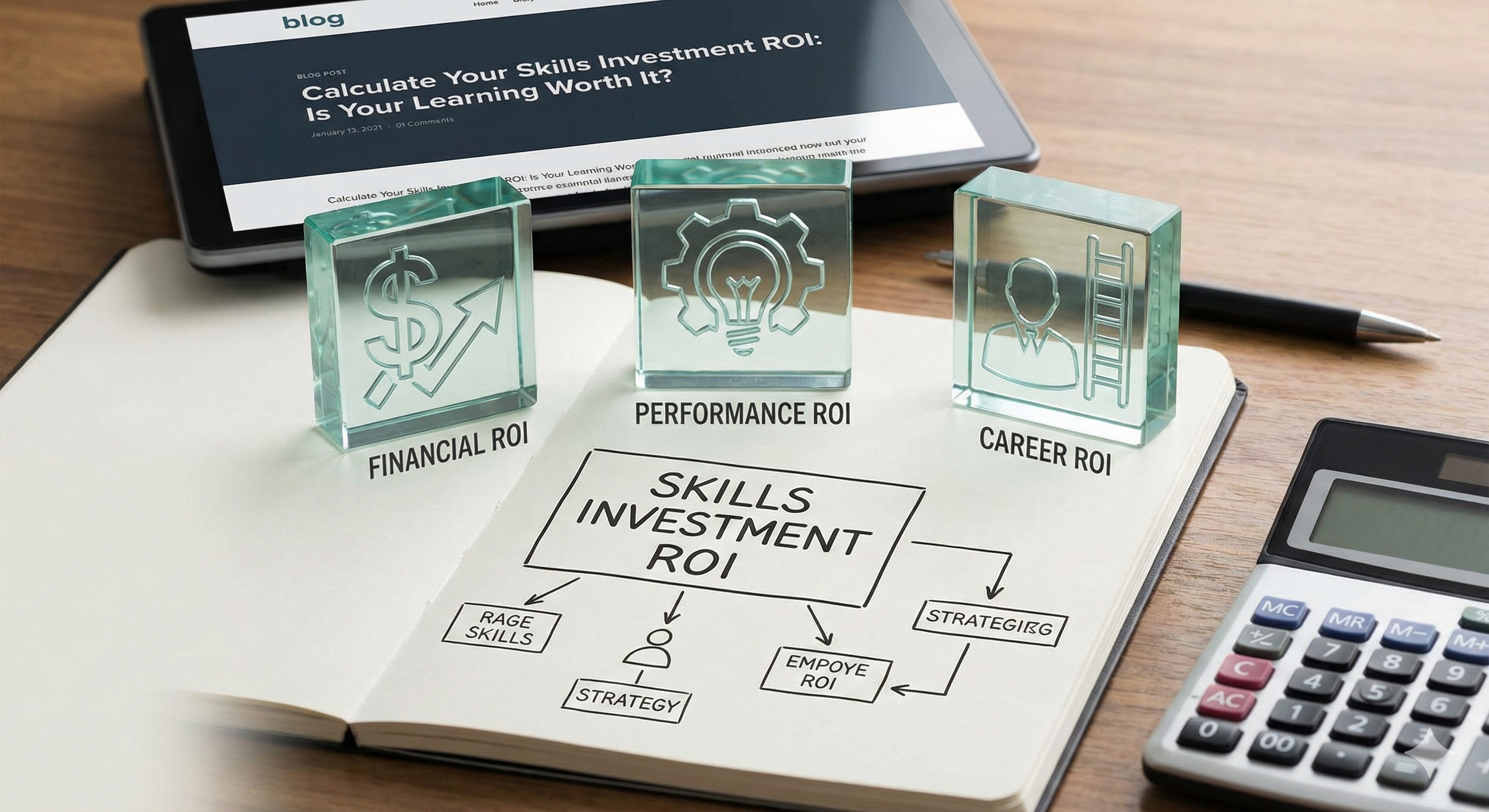
What top performers do differently: They treat skill development like an investment portfolio—tracking inputs, measuring returns, and ruthlessly cutting what doesn't pay off.
The difference? Professionals who actively measure their learning ROI earn 23% more and advance 40% faster than those who learn randomly.
Let's calculate whether your learning efforts are actually worth it.
The Real Cost of Learning (What You're Actually Investing)
Before measuring ROI, you need to know what you're investing. Most people dramatically underestimate this.
Direct Costs (Easy to Track)
Course fees: $0-2,000 per course
Books and resources: $100-500 annually
Tools and software: $200-1,000 annually
Certifications: $300-3,000 per cert
For the average professional: $1,000-5,000 per year in direct costs.
Indirect Costs (The Hidden Drain)
Time investment:
- 10 hours/month learning = 120 hours/year
- At $50/hour opportunity cost = $6,000/year
- Plus: Cognitive load, decision fatigue, family time
Opportunity cost:
- Could you earn more consulting those hours?
- What projects are you not doing?
- What relationships are you not building?
Total real investment: Often $10,000-15,000 annually when you count everything.
The question: Are you getting that back?
The Three Types of Learning ROI
Not all learning delivers the same type of return. Understanding which you're chasing matters.
Type 1: Direct Financial ROI
Measurable outcomes:
- Salary increase
- Promotion with raise
- New job with higher comp
- Side income from new skills
- Reduced expenses (automation, efficiency)
Example: Learn SQL → Automate reports → Save 5 hours/week → Take on higher-value projects → Get promoted → $15K raise
ROI calculation: Easy. Did you make more money? How much?
Type 2: Career Capital ROI
Measurable outcomes:
- Job security (harder to replace)
- Career optionality (more opportunities)
- Faster advancement trajectory
- Access to better roles/companies
- Professional reputation
Example: Learn AI tools → Become the "AI person" on your team → Get tapped for strategic projects → Visibility with leadership → Better opportunities
ROI calculation: Harder, but real. What doors opened?
Type 3: Quality of Life ROI
Measurable outcomes:
- Less stress (work is easier)
- More autonomy (trusted with complex work)
- Better work-life balance (efficiency gains)
- Intellectual satisfaction
- Confidence and competence
Example: Learn project management → Coordinate work better → Fewer fire drills → Leave on time → Better mental health
ROI calculation: Qualitative, but valuable. Is your life better?
Most learning delivers a mix of all three. The best investments deliver all three simultaneously.
The ROI Calculation Framework
Let's make this concrete. Here's how to calculate whether your learning is worth it.
Step 1: Calculate Total Investment
Track for one year:
Direct costs:
- Course fees: $______
- Books/resources: $______
- Tools/software: $______
- Certifications: $______
- Subtotal: $______
Time investment:
- Hours spent learning: ______ × your hourly rate ($) = $
Opportunity cost (optional):
- What else could you have done? $______
Total investment: $______
Step 2: Calculate Direct Returns
Financial gains in past 12 months attributed to learning:
- Salary increase: $______
- Promotion raise: $______
- New job comp increase: $______
- Freelance/consulting income: $______
- Efficiency gains (time saved × rate): $______
- Total direct return: $______
Direct ROI = (Total Return - Total Investment) / Total Investment × 100
Example:
- Investment: $8,000 (courses + time)
- Return: $15,000 (raise from new skills)
- ROI: ($15K - $8K) / $8K = 87.5% ROI
Benchmark: Good learning ROI is 50-200% in year one, compounding over time.
Step 3: Calculate Indirect Returns
Career capital gains (assign value):
- New job opportunities you qualified for: $_______
- Projects you could lead that you couldn't before: $_______
- Professional recognition/reputation: $_______
- Job security value (peace of mind): $_______
Quality of life gains (assign value):
- Hours saved per week × 52 × rate: $_______
- Stress reduction (therapy cost avoided?): $_______
- Work satisfaction increase: $_______
Total indirect returns: $_______
Note: These are harder to quantify but often exceed direct returns long-term.
Step 4: Project Future Returns
The compound effect:
- Year 1: Direct ROI
- Year 2: Continued applications + new opportunities = 1.5-2x Year 1
- Year 3: Compounded career trajectory = 2-3x Year 1
- Years 4-5: Exponential divergence from peers = 5-10x Year 1
Example: $15K raise in Year 1 → Faster subsequent raises → Different career trajectory → $100K+ difference over 5 years.
Real Examples: Learning ROI in Action
Case Study 1: The Positive ROI
Profile: Marketing manager, 5 years experience
Investment:
- SQL course: $400
- Time: 60 hours over 3 months
- Total: $3,400 ($400 + 60 hrs × $50/hr)
Returns (Year 1):
- Automated weekly reports: 3 hours saved/week = $7,800/year
- Led data-driven campaign that generated $50K incremental revenue
- Positioned for promotion to Senior Manager (+$12K salary)
Direct ROI: 482% in year one
Indirect ROI: Now speaks "data" fluently, seen as more strategic, invited to higher-level meetings
Verdict: Excellent investment
Case Study 2: The Negative ROI
Profile: Software engineer, 8 years experience
Investment:
- Machine learning bootcamp: $2,500
- Time: 120 hours over 4 months
- Total: $8,500
Returns (Year 1):
- Hasn't applied ML skills at work (company doesn't have ML needs)
- No salary increase
- No new opportunities
- Certificate sits on LinkedIn
Direct ROI: -100% (total loss)
Indirect ROI: Minimal. Learned something interesting but not career-relevant.
Verdict: Poor investment (for this person's situation)
Lesson: Learning something cool ≠ learning something valuable for your career
Case Study 3: The Delayed ROI
Profile: Product manager, 3 years experience
Investment:
- Public speaking course: $800
- Practice time: 40 hours
- Total: $2,800
Returns (Year 1):
- Gave one team presentation (better than before)
- No immediate financial gain
ROI Year 1: -100%
Returns (Year 2):
- Volunteered to present at industry conference
- Got noticed by executive at different company
- Recruited for Senior PM role (+$25K)
ROI Year 2: 789%
Verdict: Great investment with delayed payoff
Lesson: Some skills compound slowly then deliver massive returns
When Learning Is NOT Worth It
Be honest about these red flags:
Red Flag 1: Learning for Learning's Sake
The trap: "This is interesting, I should learn it"
The reality: Interesting ≠ useful for your career
The fix: Ask "How will I apply this in the next 30 days?"
If you can't answer specifically, don't invest time.
Red Flag 2: Certificate Collecting
The trap: "Another cert will make me more hireable"
The reality: Most certifications have minimal ROI
The fix: Only pursue certifications if:
- Required for the role you want
- Demonstrated to open specific doors
- Paired with applied project work
Red Flag 3: Following Hype
The trap: "Everyone's learning [trending technology], I should too"
The reality: By the time something's hyped, the opportunity may have passed
The fix: Learn what your specific career path needs, not what Twitter says is hot
Red Flag 4: Learning Without Applying
The trap: "I'll learn this deeply before I use it"
The reality: You forget 80% if you don't apply within 2 weeks
The fix: Find application opportunities BEFORE investing in learning
Red Flag 5: Random Walk Learning
The trap: "I'll learn a bit of everything"
The reality: Jack of all trades, master of none → No competitive advantage
The fix: Depth in 2-3 skills beats breadth in 10 skills
If any of these describe your learning approach, your ROI is probably negative.
How to Improve Your Learning ROI
Strategy 1: Be Ruthlessly Selective
Before starting any learning:
- What specific outcome am I trying to achieve?
- How will I apply this in the next 30 days?
- What will this enable me to do that I can't do now?
- Is this the most direct path to that outcome?
- What's my expected ROI?
If you can't answer all five, don't start.
Strategy 2: Double Down on Winners
Track what's working:
- Which skills generated immediate value?
- Which opened unexpected doors?
- Which do you actually enjoy using?
Do more of those. Cut everything else.
Example: If learning Excel VBA saved you 100 hours last year, learn Power Query this year. If learning Photoshop didn't lead to anything, stop investing there.
Strategy 3: Create Application Forcing Functions
Don't just learn—set up situations where you must apply:
- Volunteer for a project requiring the new skill
- Commit to a deliverable using it
- Teach the skill to someone else
- Build something real (not tutorial projects)
The forcing function creates accountability and ensures ROI.
Strategy 4: Measure and Iterate Monthly
Monthly review:
- Time invested this month: ______
- Value created this month: ______
- ROI trending up or down?
- What's working? What's not?
- Should I continue, pivot, or stop?
If ROI is negative for 3 consecutive months, kill it.
Strategy 5: Optimize for Compound Returns
The best learning investments compound:
Linear returns: Learn Photoshop → Make images → Same value forever
Compound returns: Learn data analysis → Make better decisions → Build reputation → Get strategic opportunities → Accelerate career trajectory
Prioritize skills that:
- Apply to multiple contexts
- Become more valuable as you advance
- Create network effects
- Open doors to other skills
The 2026 Learning Portfolio Strategy
Think of learning like investing. You want a portfolio:
70% Core Skills (High ROI, Safe)
Skills directly needed for your current role:
- Immediate application
- Clear ROI
- Low risk
Example: Project manager learning advanced stakeholder management techniques
20% Adjacent Skills (Medium ROI, Moderate Risk)
Skills that expand your capabilities:
- Near-term applicability
- Moderate ROI potential
- Opens new opportunities
Example: Analyst learning basic SQL to complement Excel skills
10% Exploratory (Uncertain ROI, High Risk)
Skills that might be game-changers:
- Longer-term bet
- Uncertain payoff
- Could be transformational
Example: Traditional marketer exploring AI tools for content creation
Rebalance quarterly. If exploratory bets aren't paying off, reallocate to core.
Your 2026 Learning Audit
Take 30 minutes right now:
Step 1: List Everything You've Learned in 2025
- Courses taken: _________________
- Skills developed: _________________
- Certifications earned: _________________
- Time invested: _________________
- Money spent: _________________
Step 2: Calculate ROI for Each
- Direct financial return: $_______
- Indirect career value: $_______
- Quality of life improvement: _______
- Overall ROI: _______
Step 3: Identify Patterns
- What had highest ROI? _________________
- What had negative ROI? _________________
- What surprised you? _________________
- What would you do differently? _________________
Step 4: Plan 2026 Investments
Based on 2025 results:
Double down on (high ROI): _________________
Continue (moderate ROI): _________________
Stop (negative ROI): _________________
Explore (new bets): _________________
Step 5: Set ROI Targets
2026 Learning Budget: $_______
Target ROI: _______%
How will I measure: _________________
Monthly review date: _________________
The Bottom Line
Learning for the sake of learning is a hobby.
Learning with ROI in mind is a career investment.
Both are valid—but don't confuse them.
If you're spending $10,000 and 100+ hours annually on learning, you deserve to see returns. Not just in dollars (though that matters), but in career trajectory, autonomy, and quality of life.
The professionals who win in 2026:
- Treat learning as investment, not consumption
- Measure ruthlessly
- Double down on what works
- Cut what doesn't
- Compound returns over time
The professionals who stagnate:
- Learn randomly without strategy
- Never measure impact
- Collect certificates, not capabilities
- Wonder why their career isn't advancing
Which one will you be?
Your 2026 learning ROI starts with your next decision about what to learn—and whether it's actually worth your time.
Make it count.